
Timing: 6:00am-2:00pm

The pre-gymnasium track (VP) is one of the two pathways at lower secondary level in the Canton of Vaud. It welcomes students from 9th to 11th grade of compulsory schooling and prepares them directly for Swiss Matura studies, and therefore for university, universities of applied sciences, and other higher education institutions. It is a demanding pathway, governed by the Law on Compulsory Education (LEO), which requires a strong level in core subjects and a clear educational plan.
In the Canton of Vaud’s school system, compulsory education lasts 11 years. After primary school (grades 1 to 8), students enter secondary school, also known as lower secondary level, which lasts three years, from 9th to 11th grade. This cycle includes two pathways: the pre-gymnasium track (VP) and the general track (VG).The pre-gymnasium track is intended for students whose academic performance and school record allow them to aim for gymnasium studies. From the first year of this cycle, students follow a demanding curriculum governed by the Law on Compulsory Education (LEO), which came into force in 2013, and aligned with the Plan d’études romand (PER), the same framework used in public schools in Vaud.At the end of 11th grade, students obtain a lower secondary certificate from the pre-gymnasium track, which grants access to public gymnasium in the Canton of Vaud.
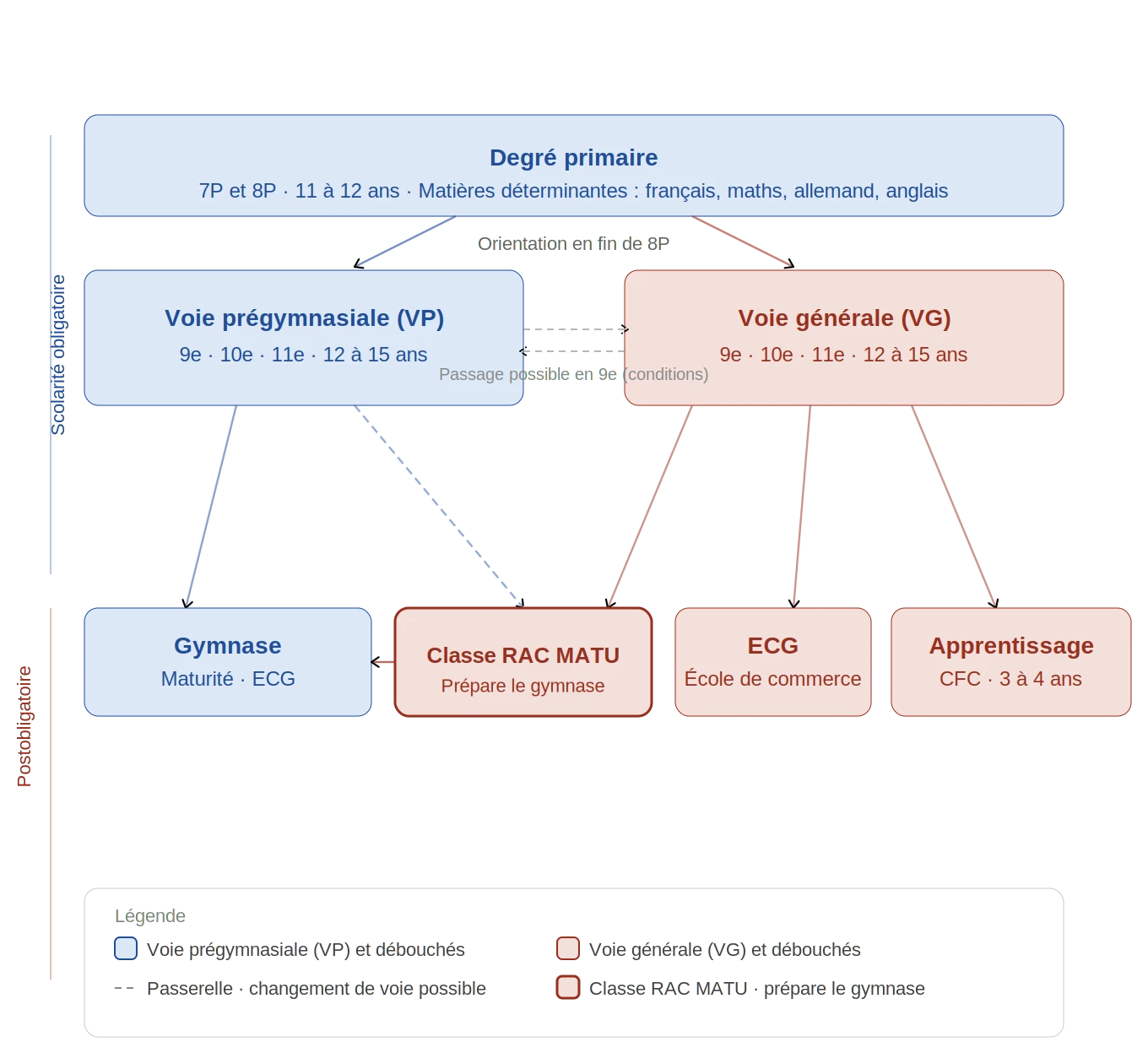
La voie prégymnasiale (VP) prépare les élèves qui visent la maturité gymnasiale, puis potentiellement l'université ou une formation professionnelle supérieure. Elle est exigeante, avec un niveau soutenu en français, mathématiques, allemand et anglais sur trois ans.
La voie générale (VG) prépare les élèves à l'apprentissage en entreprise avec un certificat fédéral de capacité (CFC), à l'école de culture générale ou à l'école de commerce. Elle n'est pas une voie de second choix : elle correspond à des profils d'élèves concrets, avec des débouchés solides sur le marché du travail en Suisse romande et au-delà. Des passerelles existent pour rejoindre la VP ou le gymnase, si le projet de l'élève évolue.
The pre-gymnasium track (VP) lasts 3 years, from 9th to 11th grade of compulsory schooling. At the end of 11th grade, a certification exam is held. Students who obtain their lower secondary pre-gymnasium certificate can directly enter gymnasium at the start of the following school year.For more information on the official structure of the lower secondary cycle, the Canton of Vaud provides an overview including timetables, certification requirements, and brochures for parents.
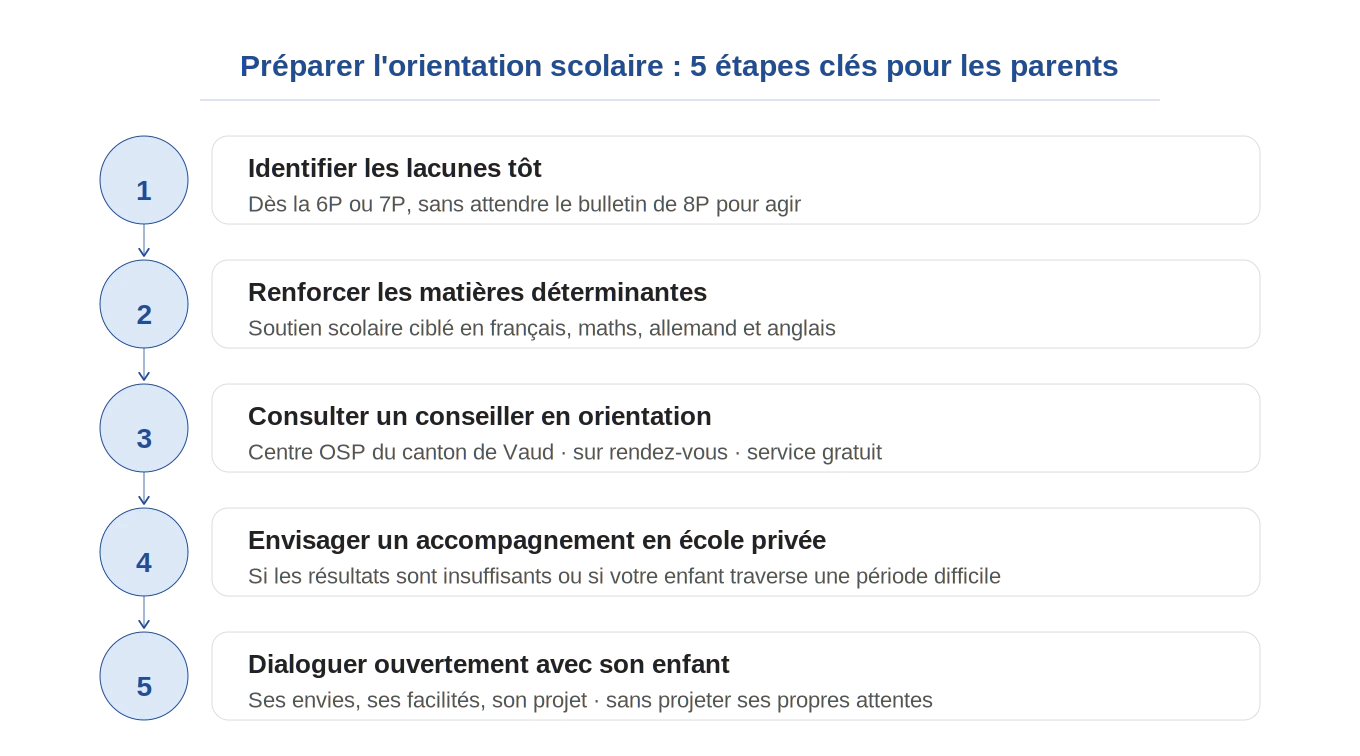
Voici cinq démarches concrètes qui font une différence réelle :
At the end of 8th grade of primary school, the school’s governing board directs each student toward either the pre-gymnasium track or the general track, based on their academic results. This decision is a key milestone in the child’s educational pathway: it determines entry into the third cycle of compulsory schooling, which leads directly to gymnasium for VP students.In the public system, the standardized cantonal assessments (ECR) in 8th grade—French, mathematics, and German—play a decisive role in this decision. They account for 30% of the final annual grade, while the remaining 70% comes from continuous assessment throughout the school year. A few hours of testing can therefore have a significant impact on a student’s orientation.For students in private schools, placement is based solely on continuous assessment, without ECR exams. This is one of the practical advantages of private schooling: students are evaluated on their overall performance throughout the year, without their orientation depending on a single exam taken over a few hours.At École Vinet, a structured and high-quality teaching organization is implemented throughout the year to ensure that each student develops the skills expected in the VP track: rigor, autonomy, and the ability to work consistently and methodically.
C'est la première chose à retenir : une orientation en voie générale n'est pas un échec. C'est une filière à part entière, conçue pour des profils d'élèves qui apprennent souvent mieux par la pratique, qui ont un projet professionnel plus concret, ou qui ont simplement besoin d'un peu plus de temps pour trouver leur rythme.
Les débouchés sont réels et variés : place d'apprentissage dans des centaines de secteurs différents, offre d'apprentissage en entreprise sur l'ensemble du marché vaudois et suisse, accès à l'école de commerce, à l'école de culture générale ou à des formations professionnelles reconnues. Beaucoup d'élèves orientés en VG construisent des parcours solides, épanouissants et bien ancrés sur le marché du travail.

Admission criteria for the pre-gymnasium track are based on results in two groups of subjects, according to a structure defined by the Law on Compulsory Education (LEO):
The timetable for the pre-gymnasium track includes a common core of fundamental subjects taught to all students:
En tant que parent, soyez attentif aux signaux qui doivent vous alerter : un repli progressif sur soi, une anxiété inhabituelle autour des résultats, une baisse soudaine de motivation ou un désengagement scolaire. Ces signaux ne sont pas des caprices. Ils indiquent souvent qu'un enfant a besoin d'un espace de parole et d'un soutien adapté.
These subjects are taught at a homogeneous level in the pre-gymnasium track (VP), unlike in the general track (VG), where certain subjects are taught at two levels (N1 and N2). This is one of the defining features of this pathway: all students follow the same demanding curriculum.
La différence entre s'impliquer et projeter ses attentes est souvent ténue. S'impliquer, c'est aider votre enfant à comprendre les enjeux et à préparer cette étape avec sérénité. Projeter, c'est faire porter à votre enfant le poids d'une ambition qui n'est pas la sienne.
Un cadre scolaire à effectifs réduits, comme celui que propose l'École Vinet, peut réduire concrètement ce stress : les enseignants connaissent chaque élève, les entretiens individuels sont réguliers, et les ressources d'accompagnement sont accessibles au quotidien, sans délai d'attente.
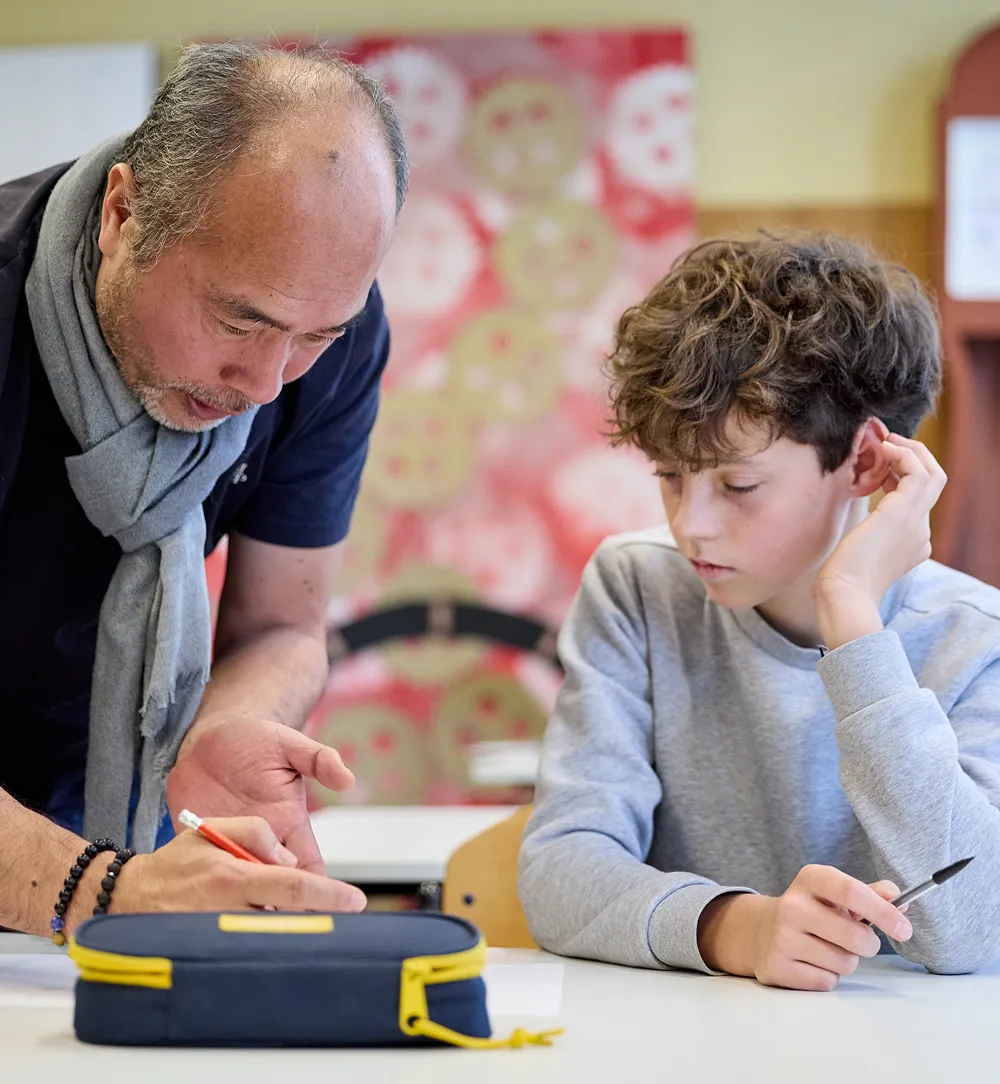
Dans le système public, un enseignant gère en moyenne 20 à 25 élèves par classe. Le suivi est possible, mais il est nécessairement limité par le nombre. A l'École Vinet, les effectifs réduits permettent à chaque enseignant de connaître précisément le niveau, les forces et les fragilités de chaque jeune, bien avant que l'orientation ne devienne une urgence.
Ce suivi précoce change la donne : plutôt que de découvrir les lacunes au moment où le bulletin de 8P est déjà imprimé, le suivi à Vinet permet d'intervenir dès la 7P, de renforcer les compétences clés et d'aborder la fin du primaire avec des bases solides. La progression est visible, mesurable, et rassurante pour l'enfant comme pour ses parents.
Choosing the “easiest” OS instead of the one that matches the student’s educational and career goals. Opting for economics and law because Latin feels intimidating, or choosing Latin because the student is “not good at maths,” without considering what they want to do after gymnasium. These choices may still work, but they should be made with full awareness of their implications.
The right time to make this decision is not in a rush at the start of 9th grade, but after a guided reflection process beginning at the end of 8th grade. An academic advisor can help the student identify their strengths, interests, and educational goals, and choose the OS that truly aligns with them.
This is one of the questions parents ask most often—and the answer is yes, under certain conditions.The Vaud school system, in the spirit of the LEO, was designed to remain flexible. Bridges between the two tracks are possible at several points during lower secondary education:
These reorientations are always made in the student’s best interest, to help them progress in the pathway that best matches their actual abilities and educational goals.This system of flexible pathways is intended to be one of the strengths of the Vaud school system: it prevents a child’s academic trajectory from being fixed by a decision made at the age of 12.
In practice, however, this is not always the case, which is why private schools can play a significant role. This information is available in the official cantonal brochures; do not hesitate to share it with your child so they can also understand the options available to them.
.svg)
.svg)


