


Academic and career guidance in Lausanne comes to a head at the end of 8th grade of primary school, when each student is directed towards the pre-gymnasium track (VP) or the general track (VG). This choice opens up very different paths towards gymnasium, apprenticeships, vocational maturity, or other post-compulsory options. Choosing the right academic path for your child's personality and strengths is a question many families face, without always knowing which resource to turn to or which organisation or person to contact first. This page offers practical guidance on how academic and career orientation works in the Canton of Vaud: decision criteria, available tracks, support options, and links to the canton's main educational resources. Here is everything you need to know.
The essentials in 1 minute
- Academic orientation is decided at the end of 8P, based on results in French, mathematics, German, and English.
- Two tracks exist: the pre-gymnasium track (VP), which leads to gymnasium and the Matura, and the general track (VG), which opens the way to apprenticeships, business school, or the school of general culture.
- Orientation is not irreversible: bridges exist from 9th grade through to the end of compulsory schooling to change track or access gymnasium.
- Planning ahead as early as 7th grade of primary school (7P) makes a real difference to 8P results.
- To avoid going through this period alone, personalised support at a school like École Vinet helps prepare for orientation from 7P onwards, with a guidance counsellor on site two days a week
What is academic orientation in the Canton of Vaud?
The key moment: the end of 8th grade of primary school (8P)
In the Canton of Vaud, the school system is governed by the Law on Compulsory Education (LEO). At the end of 8P, every student reaches a decisive step: academic and career orientation towards lower secondary school. This is not simply a change of school. It is a fork in the road that shapes the options available for the following three years and, to a large extent, for the rest of their studies and career.
In practice, many families find themselves unprepared for this moment. The criteria can seem unclear, the pressure around choosing the right path is real, and information does not circulate evenly between schools. Understanding how academic orientation works ahead of time already gives your child a head start.
VP or VG: two tracks, two different paths in life
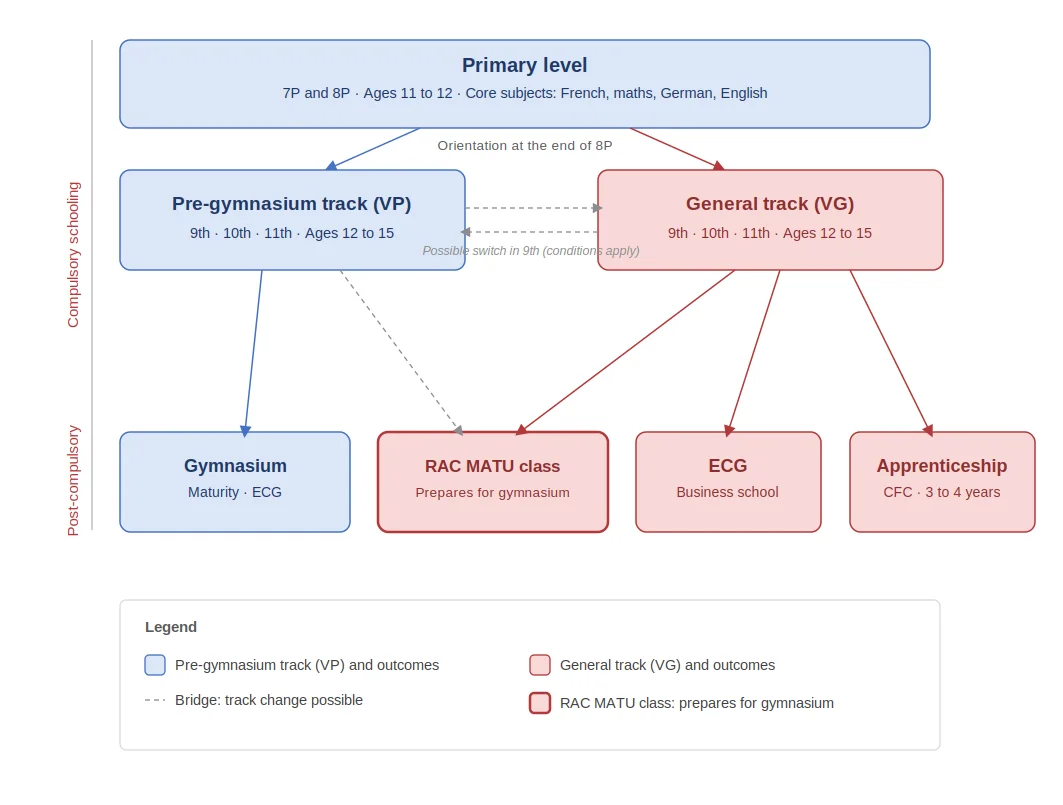
The pre-gymnasium track (VP) prepares students aiming for gymnasium maturity, and potentially university or higher professional training beyond that. It is demanding, with a sustained level in French, mathematics, German, and English over three years.
The general track (VG) prepares students for a company apprenticeship leading to a federal certificate of proficiency (CFC), for the school of general culture, or for business school. It is not a second-choice path: it matches concrete student profiles, with solid career opportunities across French-speaking Switzerland and beyond. Bridges exist to join the VP track or gymnasium later, if the student's plans change.
Comparison table: VP vs VG
How is the orientation decision made at the end of primary school?
The criteria considered for orientation
The orientation decision is not based on a single exam taken at the end of the year. It is built on the student's entire school record, mainly their results in French, mathematics, German, and English, the four subjects considered determining under the LEO system. The teacher's assessment, behavioural feedback, and the consistency of results across 7P and 8P also play an important role.
This is precisely why targeted academic support, started early, is far more effective than a last-minute push in 8P. Skills are built up over time, not in a matter of weeks.
What parents can do to prepare for this step
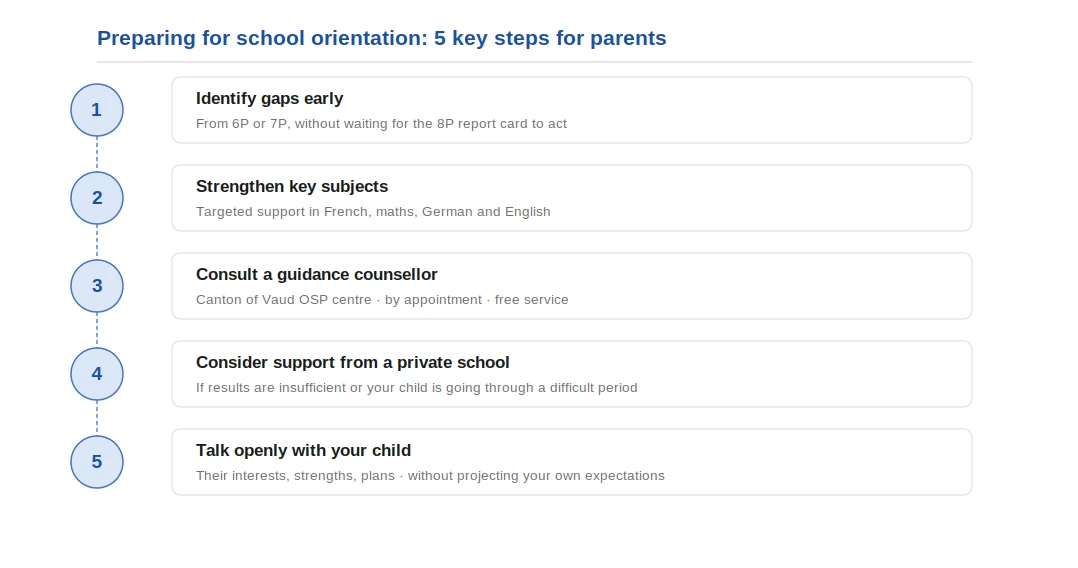
Here are five concrete actions that make a real difference:
- Identify gaps as early as 6P or 7P, rather than waiting for a surprise on the 8P report card.
- Strengthen key subjects with tailored, regular, and personalised academic support.
- Consult a guidance counsellor at an OSP centre, available by appointment across the Canton of Vaud, for neutral, informed advice on the choice of pathway.
- Consider support from a private school if results are insufficient or if your child is going through a difficult period affecting their progress.
- Talk openly with your child about their interests, strengths, and plans, without projecting your own expectations onto their path.
If you feel your child needs a more structured framework to approach this step calmly, École Vinet offers close support from 7P onwards, with small class sizes and a guidance counsellor based at the school. A way to turn this period of uncertainty into a genuine springboard.
Is your child approaching orientation?
Let's talk about itMy child hasn't been placed in VP: what are the practical solutions in Lausanne?
The general track is not a second-choice path
The first thing to remember: being placed on the general track is not a failure. It is a fully-fledged pathway, designed for students who often learn better through practice, who have a more concrete career plan, or who simply need a little more time to find their pace.
The opportunities are real and varied: apprenticeship placements across hundreds of different sectors, apprenticeship offers throughout the Vaud and Swiss job markets, access to business school, the school of general culture, or recognised vocational training. Many students on the VG track go on to build solid, fulfilling careers, firmly established in the job market.

The options available from 9th grade to gymnasium
No door closes for good at the end of 8P. Here are the options available, in chronological order.
- During compulsory schooling: a student on the VG track can move to VP based on results, at the latest by the end of the first semester of 9th grade. This transition requires a solid level in key subjects and rigorous follow-up.
- At the end of 11th grade, via Raccordement 1: for students who have completed compulsory schooling in VG and wish to access the school of general culture or business school at gymnasium level. This path is demanding but accessible with the right support.
- At the end of 11th grade, via Raccordement 2: to obtain the VP certificate and access gymnasium maturity studies. This is the most ambitious bridge from VG, requiring genuine catch-up work in key subjects.
- VP at École Vinet: as admission conditions for VP are slightly different from the public system, École Vinet offers an accessible pre-gymnasium track, with more sustained support from the start of 9th grade.
- The RAC MATU class at Vinet: for students wishing to join a public gymnasium after compulsory schooling, regardless of their original track (VP, VG, or CFC), Vinet offers a rigorous and supportive transition year. This preparation programme focuses on the requirements of the cantonal gymnasium admission exams, with targeted reinforcement in French, mathematics, German, and English, small class sizes, and individualised support. At the end of this year, options include gymnasium (maturity or general culture track), business school, or a supported reorientation if the student's plans change.
- By repeating 9th grade: a student on the VG track may move to VP the following year, if their results and level justify the switch.
Is your child looking for a solution after their orientation?
Let's talk about itHow can you help your child experience the orientation period calmly?
What a 7P or 8P student feels about orientation
For many students, the orientation period comes with a quiet but very real pressure: pressure around grades, comparisons with classmates, fear of disappointing others, or the feeling of being judged by a label that will follow them for years. This stress can sometimes lead to unexpected reactions in children, and can also affect family life, with stressed parents or tension at home.
As a parent, watch for warning signs: gradual withdrawal, unusual anxiety around results, a sudden drop in motivation, or disengagement from school. These signals are not whims. They often mean a child needs space to talk and the right kind of support.
Supporting without adding pressure: a few pointers for parents
How can you talk to your child about orientation without turning it into a performance issue? Start by exploring together what they enjoy, what they feel capable of, and what they imagine for their future, without letting your own expectations take over the conversation.
The line between being involved and projecting expectations is often a fine one. Being involved means helping your child understand what's at stake and approach this step with confidence. Projecting means placing on your child the weight of an ambition that isn't their own.
A school with smaller class sizes, like the one École Vinet offers, can genuinely reduce this stress: teachers know each student, individual meetings are held regularly, and support resources are available day to day, without waiting lists.
Why does support from a private school make a difference?
Attentive monitoring for better orientation preparation
In the public system, one teacher manages an average of 20 to 25 students per class. Monitoring is possible, but it is necessarily limited by numbers. At École Vinet, smaller class sizes allow each teacher to know precisely each student's level, strengths, and weaknesses, well before orientation becomes urgent.
This early monitoring changes everything: rather than discovering gaps once the 8P report card has already been printed, Vinet's approach allows teachers to step in as early as 7P, reinforcing key skills and approaching the end of primary school with solid foundations. Progress is visible, measurable, and reassuring for both child and parents.
What École Vinet offers students from 7P to the end of secondary school ?
Founded in Lausanne in 1839, École Vinet supports students throughout the entire secondary pathway, within the same school: 7P and 8P (primary), VP secondary (9th, 10th, 11th grade) and VG secondary (9th, 10th, 11th grade), through to post-compulsory education with the RAC MATU class and the pre-apprenticeship year.
In practical terms, here is what this organisation offers every family.
- A guidance counsellor (psychologist) is based at the school two days a week. She delivers lessons built into the timetable for 10VG, 11VG, and pre-apprenticeship classes, and remains available for individual support for students in other classes.
- Concrete tools for building a career plan: aptitude, personality, and interest tests, individual orientation assessments to identify areas to explore and analyse possible training paths.
- Hands-on experience to expose students to the realities of the job market: work-shadowing placements, visits to professional events such as SwissSkills or the Salon des métiers held in the Canton of Vaud, and meetings with professionals from different sectors.
- Active support with application files: help writing CVs and cover letters, preparation for in-person or phone interviews, follow-up on applications, and support with re-outreach.
- Families are fully included in the process: regular meetings, information on key milestones, and ongoing dialogue between parents and the teaching team. Your contact with the school is not limited to the term report card.
- At the end of secondary school, each student is guided towards the pathway that suits them: gymnasium, ECG, CFC apprenticeship, the RAC MATU class, or other vocational training, depending on their plans and results.
- For students who need extra reinforcement alongside this pathway, École Vinet also offers academic support sessions: subject-specific work, tailored to each student's level and pace, from 7th to 11th grade.
What resources are available for academic orientation in Lausanne?
Public orientation structures in the Canton of Vaud
The Canton of Vaud has a network of academic and career guidance centres, coordinated by the Office cantonal d'orientation scolaire et professionnelle (OCOSP), the canton's vocational guidance and careers service. For families in Lausanne, the OSP Centre région is the main point of contact.
The guidance counsellors who work there support students and their families in exploring career plans, choosing a pathway, and answering questions about post-compulsory options.
Additional guidance resources are also available online, in particular via orientation.ch, which lists apprenticeship openings, careers available in the Canton of Vaud, and vocational training options across French-speaking Switzerland.
The added value of a private school
The cantonal guidance office mainly steps in as the orientation decision approaches. Its role is to advise, inform, and help families make an informed choice, offering neutral, region-wide support.
École Vinet works differently: earlier, over the long term, and woven into the student's everyday school life. It is not a one-off service, but ongoing support, from 7P through to the start of post-compulsory education.
The two resources complement each other. Turning to the OSP for advice on pathways and career prospects, while relying on École Vinet to help your child succeed, whichever track they take: it is a combination that works.


